Yes. The data destruction report lists every device and drive by serial number, with the method used for each, so every drive can be traced from collection to destruction.
ITAD Documentation: Sample Certificates and Reports
Asset Audit and Disposal
A certificate of destruction is only one part of the documentation pack that every DataMove disposal and decommissioning job produces. Each document is generated from our own asset management platform.
Below are samples from a test job, so you can see exactly what you will receive before you commit.
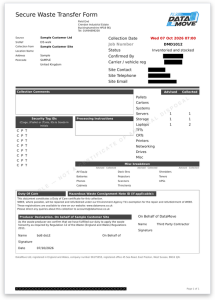
Secure Waste Transfer Form
Issued at collection. It records what was advised and what was actually collected, by category, with security tag IDs, and serves as your Duty of Care record for the collection.
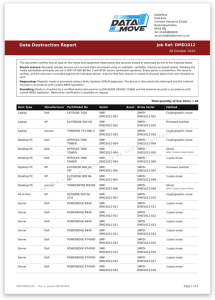
Data Destruction Report
One line per device: type, make, model, serial, asset tag, drive serial, and the method used for each drive (cryptographic erase, firmware sanitise, overwrite or shredding). A drive that fails erasure is routed to physical destruction and recorded as such.
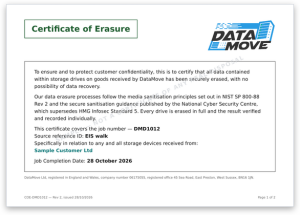
Certificate of Erasure
Confirms that every drive received was erased in full and verified, following NIST SP 800-88 Rev 2 and NCSC secure sanitisation guidance.
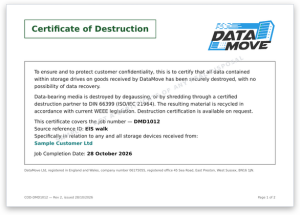
Certificate of Destruction
Confirms that data-bearing media was destroyed by degaussing or by shredding through a certified partner to DIN 66399 (ISO/IEC 21964), with the material recycled under WEEE regulations.
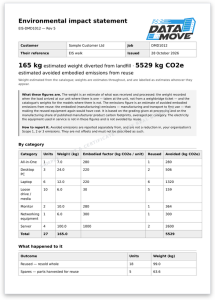
Environmental Impact Statement
An estimate of the weight diverted from landfill and the embodied emissions avoided through reuse, by category. We label every figure as an estimate, explain how it is calculated, and state clearly that avoided emissions are not offsets and are not a reduction in your Scope 1, 2 or 3 emissions.

Frequently Asked Questions
A certificate of destruction confirms that data-bearing media has been physically destroyed so that no data can be recovered. Ours states the method used, the standard it was destroyed to (DIN 66399 / ISO/IEC 21964), the job it relates to and the customer it was issued to.
A certificate of erasure confirms that drives were securely overwritten and verified, so the hardware can be reused or resold. A certificate of destruction confirms that drives were physically destroyed. Many jobs use both: erasure for working drives, and destruction for drives that fail erasure or where policy requires it.
Drives are erased using an auditable, verifiable toolset following NIST SP 800-88 Rev 2 and NCSC secure sanitisation guidance. Depending on the drive, the method is cryptographic erase, firmware sanitise or a full overwrite. Every drive is verified after erasure and the result is recorded against its serial number.
It is routed to physical destruction and recorded as such on the data destruction report, so you can see exactly which drives were erased and which were destroyed.
Yes. Drives can be shredded at your premises or data centre through our certified destruction partners, to DIN 66399 (ISO/IEC 21964), with every serial recorded before destruction.
It is your Duty of Care record for the collection. It records what was advised and what was actually collected, by category, along with security tag IDs, so there is a clear record of custody from the moment equipment leaves your site.
It can be used as supporting information, but the figures are estimates and are labelled as such. Avoided emissions from reuse are reported separately from your Scope 1, 2 or 3 emissions, are not offsets, and should not be described as a reduction in your own emissions.
Yes. For projects in Europe, drives are destroyed and recycled in the country where they sit, and you receive the same documentation pack.
Why it matters
Certificates are only as good as the records behind them. Every document in the pack is generated from the same audit data, captured against each serial number, so the certificate, the report and the asset list always agree.
Talk to us about data centre decommissioning or IT asset disposal.
