
Project Manager – EMEA – DataMove
When organisations refresh, relocate or decommission data centre infrastructure, attention naturally focuses on the new kit and the migration itself. What gets less attention — until it becomes a problem — is what happens to the data on the equipment being retired. Done properly, data erasure is a controlled, certified, auditable process. Done badly, or skipped, it’s one of the most serious compliance and security risks an organisation can carry.
This is a practical guide to what data erasure actually involves, why it matters, and what to look for when it forms part of a relocation, refresh or decommissioning project.
Why Data Erasure Matters
Every piece of storage hardware leaving your control — drives, servers, storage arrays, even networking equipment with configuration data — is a potential data breach if the data isn’t properly removed. Deleting files or reformatting a drive doesn’t erase the underlying data; it simply removes the pointers to it, leaving the data recoverable with freely available tools.
For regulated sectors — financial services, healthcare, legal, government — the consequences of getting this wrong are severe: regulatory penalties under GDPR and sector-specific rules, reputational damage, and the direct risk of sensitive data falling into the wrong hands. The obligation doesn’t end when the hardware leaves the building. It ends when the data is provably gone.
The Difference Between Deletion, Erasure and Destruction
These terms are often used interchangeably, but they mean very different things:
- Deletion — removing the file pointers. The data remains on the disk and is easily recoverable. This is not a secure method.
- Data erasure (or wiping) — overwriting the entire storage medium with patterns of data, to recognised standards, so the original data cannot be recovered. The hardware remains intact and reusable.
- Physical destruction — shredding, degaussing or otherwise physically destroying the storage medium so it can never be used again. Appropriate when hardware is end-of-life or when policy requires it.
The right choice depends on the hardware’s onward journey. Kit being redeployed or resold should be securely erased to preserve its value. Kit that’s genuinely end-of-life, or that held the most sensitive data, may warrant physical destruction.
Recognised Standards
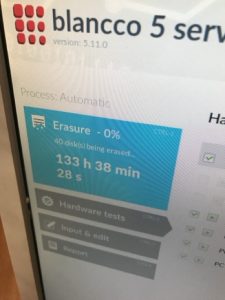
Proper data erasure is carried out to recognised standards rather than ad hoc. These define how many overwrite passes are required and how the result is verified. Certified erasure software produces a tamper-evident record for each device processed, which forms the basis of your audit trail.
The certificate is the point. Anyone can run a wiping tool. What demonstrates compliance is a documented, verifiable record showing exactly which device, identified by serial number, was erased, to what standard, when, and by whom.
Onsite vs Offsite Erasure
One of the most important decisions is where the erasure happens.
Onsite erasure means the data is destroyed before the hardware leaves your premises. For regulated data, this is often non-negotiable — the data never travels, never leaves your chain of custody intact, and there’s no window during transport where it could be lost or intercepted. For financial services and similar sectors, onsite erasure (or onsite physical destruction) is frequently the only acceptable approach.
Offsite erasure means the hardware is transported to a secure facility for processing. This can be appropriate for less sensitive data or larger volumes, but it introduces a transport phase that must itself be secured and documented, and it requires complete trust in the chain of custody.
The right answer depends on your data classification, your regulatory obligations and your risk appetite. For the most sensitive data, the principle is simple: the data shouldn’t leave the building until it’s already gone.
Data Erasure as Part of a Relocation
Data erasure frequently arises as part of a wider data centre relocation or refresh. When infrastructure moves to a new facility or jurisdiction, the old hardware often stays behind — and it still holds data. The erasure plan needs to be part of the project from the start, not an afterthought once the new kit is live.
This is particularly relevant for cross-border moves and consolidations, where equipment is being retired in one location while operations move to another. We routinely build certified erasure or destruction into relocation projects, so the retirement of old infrastructure is handled to the same standard as the migration of the new.
The Environmental Angle
There’s a sustainability dimension too. Securely erasing hardware rather than destroying it means it can be redeployed or resold for second-life use — retaining its value and avoiding the considerable embodied carbon and resources that went into manufacturing it. A single server can represent over 1.5 tonnes of CO2 in embodied carbon before it’s ever switched on. Where data classification allows erasure over destruction, it’s both the more economical and the more environmentally responsible choice.
What to Look For
If data erasure forms part of a project, the essentials to insist on are:
- Erasure to a recognised standard, not ad hoc wiping
- A certificate of erasure or destruction for every device, identified by serial number
- The option of onsite processing for sensitive data
- Full chain-of-custody documentation throughout
- Secure handling of any hardware being transported for offsite processing or disposal
- Environmentally responsible disposal or recycling of genuinely end-of-life equipment
How DataMove Can Help
We provide data erasure and disposal services, including onsite erasure and shredding, as standalone projects or as part of a wider relocation or decommissioning. Every device is processed to recognised standards, certified, and fully documented — so you have provable evidence that your data obligations have been met.