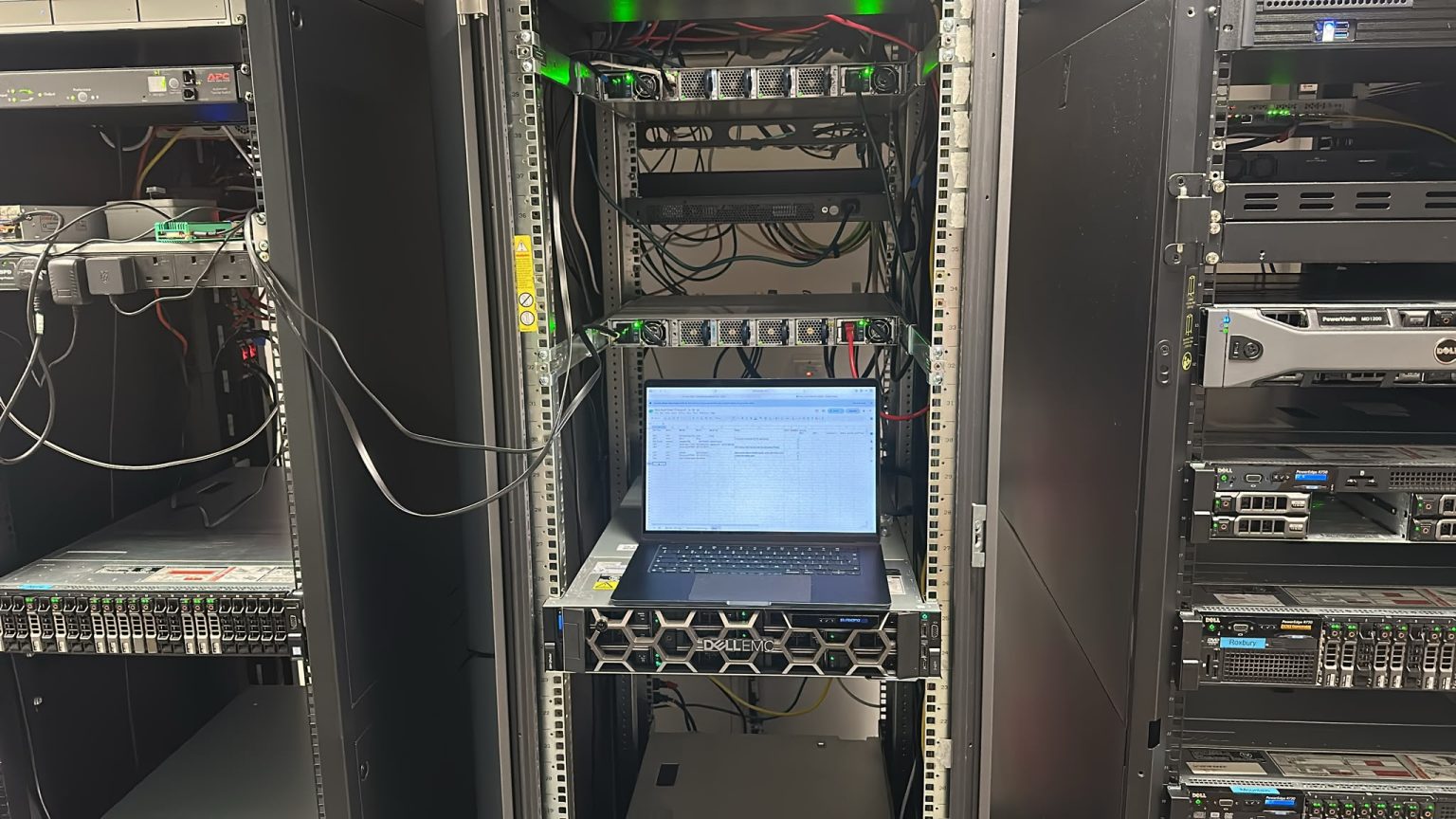
A data centre asset audit almost always finds discrepancies. Ask any IT team for a list of what is in their comms room and you will get one – it will be in a spreadsheet, it will look authoritative, and somebody will tell you it is up to date.
It will not be up to date.
This is not a criticism of anyone. It is simply what happens to a document maintained by many people over many years, none of whom are measured on whether it is accurate. Kit gets added during an emergency and never recorded. Kit gets decommissioned and never removed. A switch gets swapped under warranty and the serial changes but the sheet does not. Somebody moves two servers to another site for a project that finishes, and nobody tells the person who owns the spreadsheet.
The list drifts. It always drifts. The question is only whether you find out during an audit or during a move.
The failure most people expect
Ask someone what they think is wrong with their asset register and they will usually say the same thing: there is probably kit in there we have forgotten about.
That does happen. Undocumented equipment turns up regularly — a small switch installed for a project, a spare server left racked “temporarily” four years ago, a device somebody put in and never mentioned.
It is a real problem, and it is not the expensive one.
The failure that actually costs money
We were on a site audit recently where the opposite was true. The client’s list showed more equipment than the room actually contained.
Kit had been moved to other sites over the years. Some had been decommissioned. None of it had ever come off the sheet. The list was a record of everything the organisation had ever owned in that room — not what was in it that morning.
Now consider what happens if that list is used to plan a relocation.
You price the move for equipment that does not exist. You order transit cases for it. You allocate vehicle space by weight and volume for it. You build a floor plan at the destination with rack positions for it. You schedule engineer time to unrack, pack, transport, unpack and rack it.
Then on the night, the kit is not there.
And here is the part that stops a project: the move team cannot tell whether the equipment is missing because it was decommissioned three years ago, because it has been stolen, or because somebody moved it last week and did not say. All three look identical at 2am with a manifest in your hand and a signature to obtain.
Phantom assets do not cause a smaller move. They cause a stopped one — because nobody is willing to sign a handover document that does not reconcile.
What a proper audit actually captures
A row in a spreadsheet saying “Dell R730” is not an asset record. When we audit a room before a move, we capture:
- Make, model and serial number — verified from the device, not from the register
- Exact rack position — which cabinet, which U, front or rear facing
- Physical condition — existing damage, missing blanking plates, missing rails, missing bezels
- Power — what it draws from, which PDU, which circuit, dual-fed or single
- Connectivity — what is plugged into what, which ports are live, which are patched but dead
- Whether it is actually powered on
That last one sounds trivial and is not. On the audit above, every single device in those racks was powered on — which tells you immediately that nothing in the room was a decommissioning candidate, and that every item was in service and would need a downtime window. That is a scoping fact, and it came from looking rather than from asking.
Why the data centre asset audit has to happen before anyone picks up a screwdriver
The audit is not administrative overhead attached to the move. It is the thing that determines whether the move is priced correctly and whether it completes.
The quote. Equipment counts drive vehicle numbers, crew size, case quantities and hours. An inaccurate list produces an inaccurate price, in one direction or the other, and neither party enjoys the conversation that follows.
The manifest. Chain of custody works by signing the same document at both ends. If the document is wrong at origin, it stays wrong all the way to the destination, and the discrepancy surfaces at the worst possible moment.
The insurance. Declared value derives from what is actually being moved. Declaring equipment you no longer own is not a benefit — it is a premium paid for nothing.
The destination design. Rack elevations at the new site are built from the audit. Getting them wrong means discovering on installation night that you are two rack units short in a cabinet that is already cabled.
Do it early enough to be useful
The most common mistake is running the audit as part of the move week.
By then it can only tell you what is going wrong — it cannot change anything. Discrepancies found on the night get resolved by whoever is standing there at the time, under pressure, with a van waiting.
Run it four to six weeks out and every discrepancy becomes a question with time to answer it. Where did those two servers go? Is that switch still under warranty? Does anyone still use this? Half the time the answers reduce the scope of the move, which reduces the cost of it.
The audit routinely pays for itself by removing equipment from the project.
What we would suggest
If you are planning a relocation, a consolidation or a decommission in the next six months, the first useful step is not getting quotes. It is establishing what you actually have.
That can be your own team walking the room with a clipboard — genuinely, that is better than nothing and better than the spreadsheet. Or it can be an independent audit producing a document your suppliers can quote against and your finance team can rely on.
Either way, do it before the list becomes a contract.
DataMove carries out technical audits, asset registers and pre-move surveys across the UK, Europe and 58+ countries — as standalone work or as the first phase of a data centre relocation.
Get in touch to discuss your project.