
Project Manager – EMEA – DataMove
Most data centre projects have a date that can slip. A colocation exit is not one of them.
When a contract ends, the cage has to be empty. The operator has the next tenant lined up, the billing stops when the space is handed back, and every day beyond the date is chargeable. There is no version of the conversation where the equipment stays a little longer while someone finishes a form.
We ran a job last month that made the point neatly. A client was leaving a UK colocation facility and moving 28 units of production hardware to their own site in the United States. Air freight, not sea.
Cage to be cleared completely, including the cabinets. Fixed exit date.
The move itself went to plan. Three things did not, and all three were the sort of problem that stops a job dead if you meet them on the day rather than three weeks out.
Who actually owns the racks?
The client’s brief was straightforward: the servers come out, and so do the cabinets.
The facility’s position was different. As far as they were concerned, the cabinets belonged to them.
This is more common than people expect, and it matters enormously. If we had arrived and started unbolting on the client’s instruction, we would have been dismantling someone else’s property inside their building. If we had accepted the operator’s position without checking, the client would have paid to leave behind three cabinets they owned.
It took time to establish, and it had to be established in writing before anyone touched anything.
The underlying issue is that colocation contracts often run for years, staff change on both sides, and what was supplied by whom at the start stops being obvious. The cabinets may have come with the space. They may have been bought by the tenant and installed by the operator. They may have been swapped at some point and nobody recorded it.
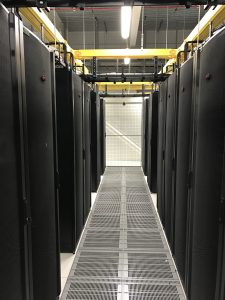
If you are planning an exit, this is worth resolving early, in writing, with the operator rather than from memory. It is not a question you want to open on the morning of the move with a crew standing in the aisle.
The paperwork starts long before the screwdrivers
Everything about moving hardware across a border has a lead time, and none of those lead times care about your exit date.
The equipment had to be classified for customs before it could be booked. Server hardware sits close to several tariff headings, and the difference between them is not academic – under the semiconductor measures now in force, the wrong code can attach a substantial surcharge to the whole shipment. Getting that right is the importer’s responsibility, and it needs the broker’s sign-off rather than a best guess.
An importer of record had to be appointed at the far end. Somebody has to be legally responsible for the goods entering the country, and that appointment takes paperwork and time.
The packing method had to be decided early too. Anything moving by air on timber pallets needs heat treatment certification under ISPM-15, not always available. We built onto air-worthy skids – three of them, roughly 880 kilograms all in.
None of this involves lifting anything. All of it has to be finished before the lifting can start.
Two tickets crossed, and it cost three hours
On the day, the crew arrived to find the equipment still powered and the PDUs not released.
The facility had raised the work as two separate tickets and the timings had crossed. Not unusual, not anybody’s fault in particular, and it was sorted out inside three hours once we were on site and could talk to the right people directly.
The reason it cost three hours rather than the day is that the schedule had room in it. A plan with no float in it is a plan that fails the first time an operator’s ticketing system does something ordinary.
That is most of what experience buys on this kind of work. Not the ability to avoid problems – you cannot – but knowing which ones are likely enough that the schedule should absorb them.
What left, and what didn’t
Twenty-eight units were retained, packed and skidded for the flight, and handed to the freight forwarder at Heathrow on schedule.
The rest did not travel. The three 47U cabinets stayed in place at the direction of the operator, whilst a set of PDUs, several firewalls, some servers and a workstation were removed for disposal. Everything with data on it was handled under a documented erasure process, with certification to follow. The WEEE side of it was documented separately.
The cage was left clear.
That last part is worth saying plainly, because it is the bit that decides whether the exit is actually complete. An operator does not accept a space back with three empty cabinets and a pile of PDUs in it. Until the cage is genuinely empty, the contract has not ended and the billing has not stopped.
The lifting is the easy part
There is a version of this industry that sells the physical work — the crews, the vans, the careful handling. All of that is real, and it matters.
But on this job, the equipment was never at risk. What was at risk was the exit date, and the things that threatened it were an ownership question nobody had settled, a customs classification that needed a specialist decision, an importer appointment at the other end, a packing standard driven by aviation rules, and an operator’s ticket that fired at the wrong time.
None of those are solved with a trolley.
If you are looking at a colocation exit with a date attached to it, the useful question is not who can move the equipment. Most competent firms can move equipment. The question is who is going to identify the constraints early enough that they do not become the reason you miss the date.
DataMove specialises in cross-border data centre relocation, migration and decommissioning, working across the UK, Europe and internationally. If you have an exit date and a room full of equipment, we are happy to talk it through.