Equinix Slough to the USA: Preparing Servers for Air Freight
In August we de-installed servers and storage for a US IT company at Equinix LD5 in Slough and prepared the servers for air freight to the United States. The equipment left the data centre on three pallets and was handed to the air freight agent at Heathrow the same day.
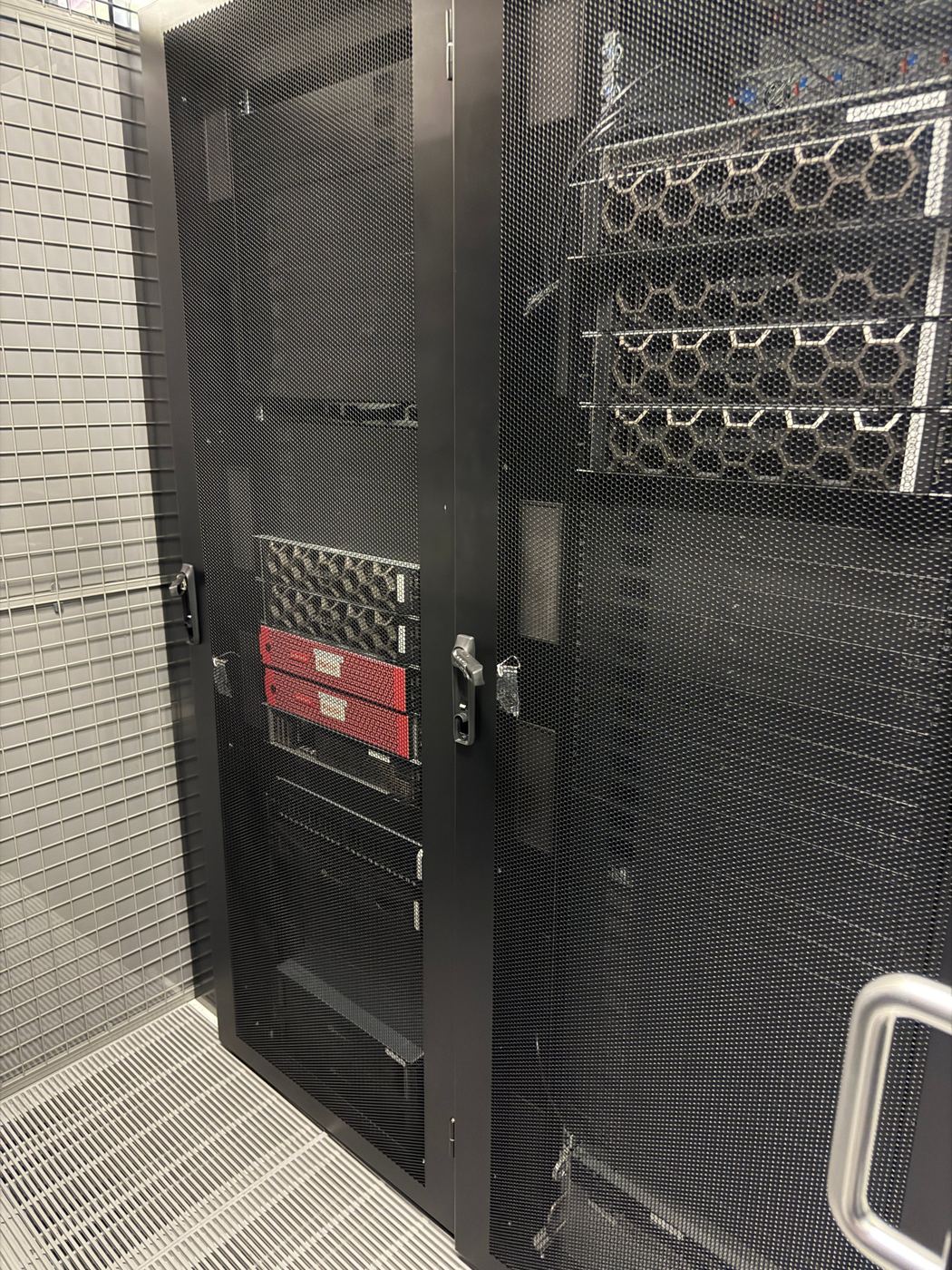
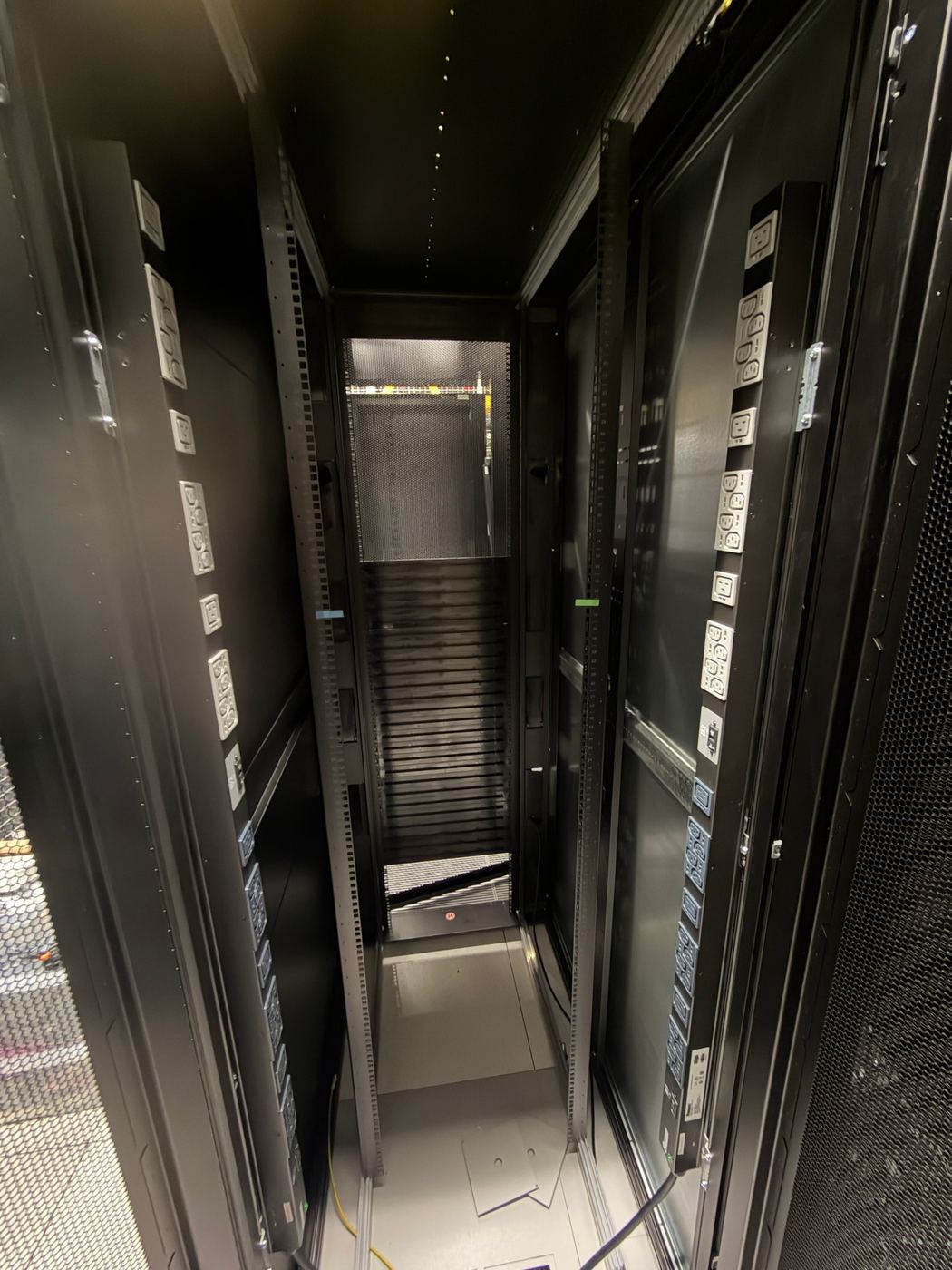
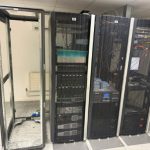
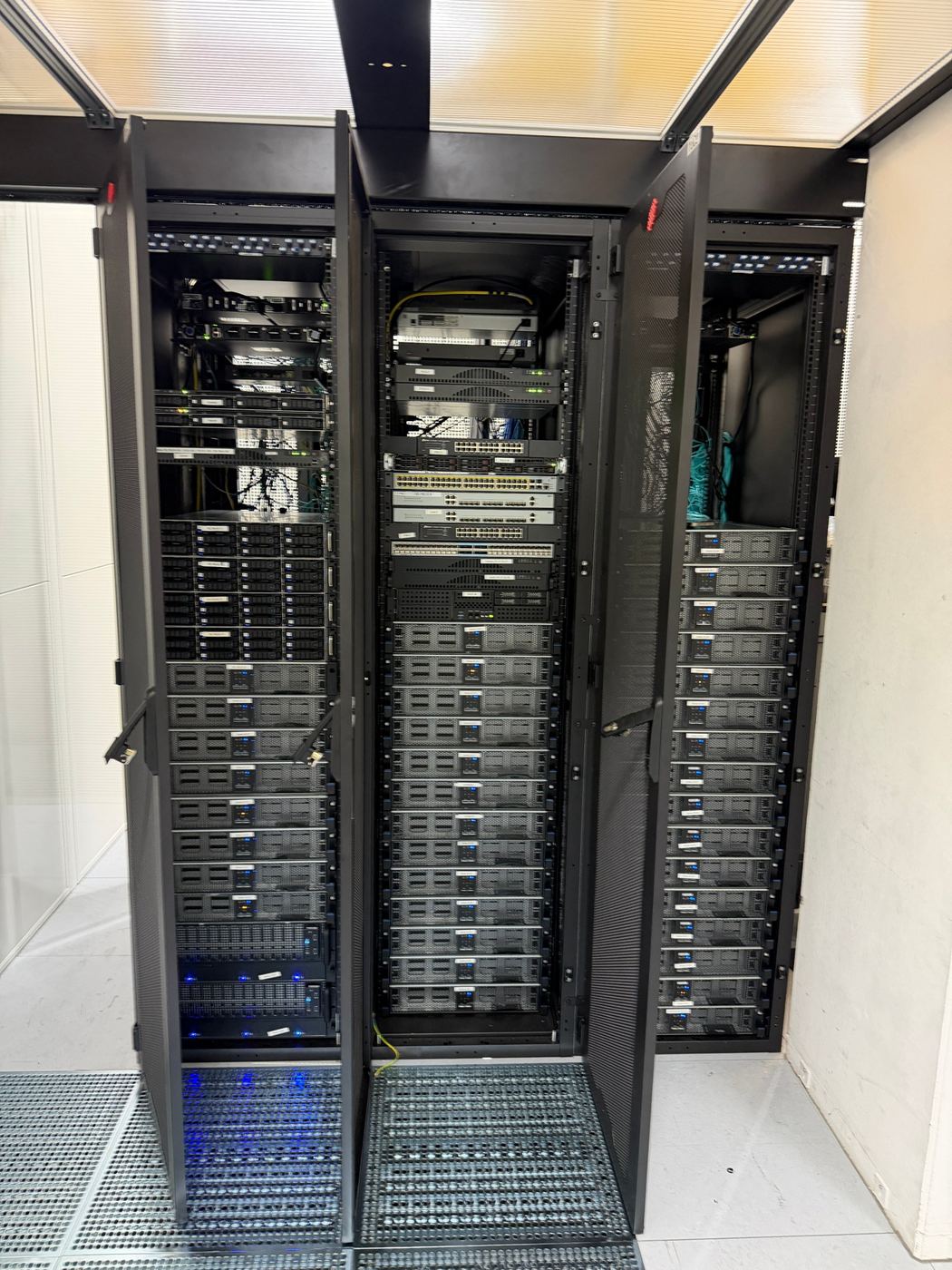
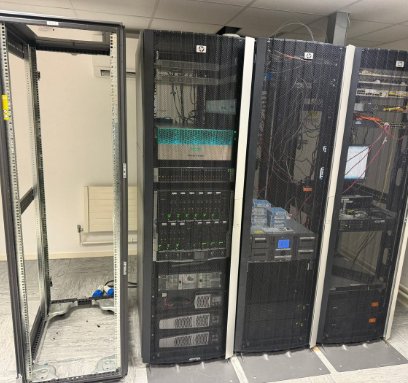
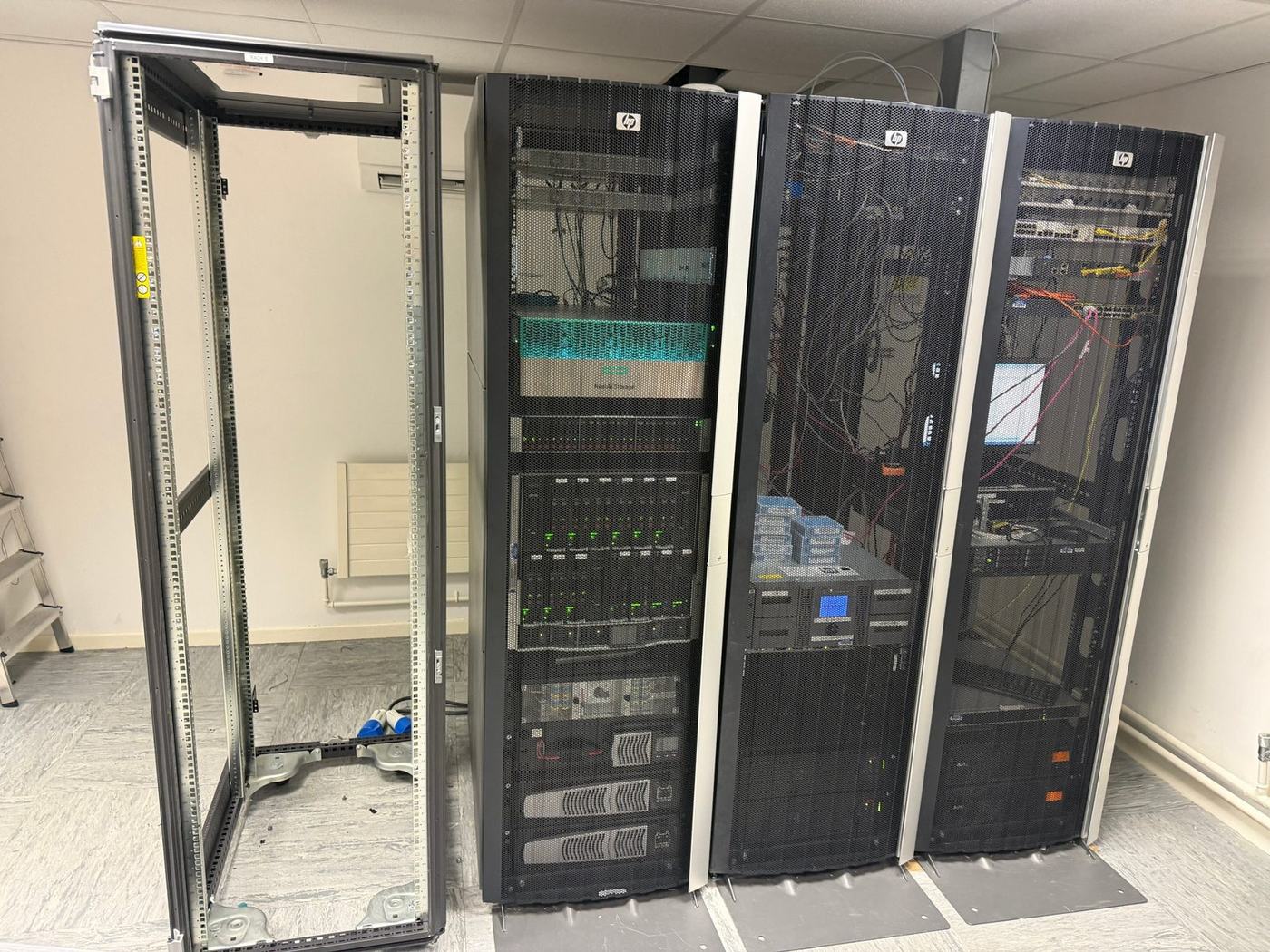
The racks at Equinix Slough before we started
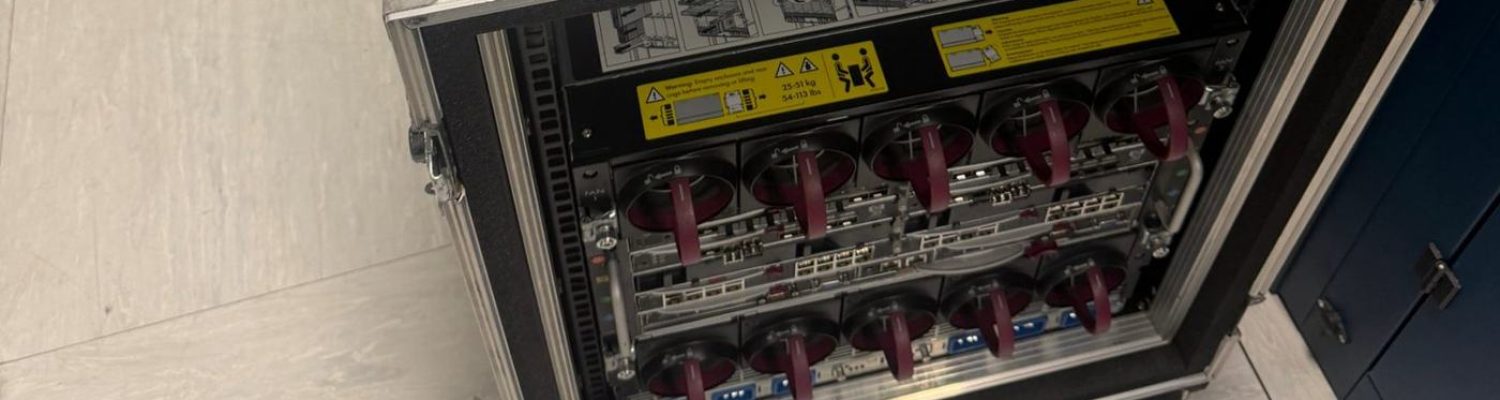
What came out
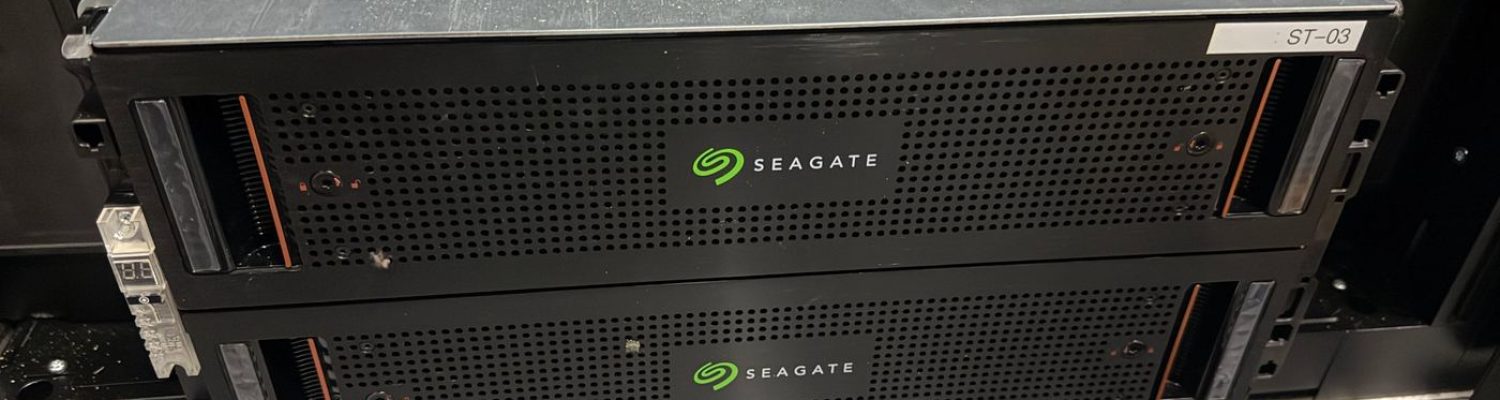
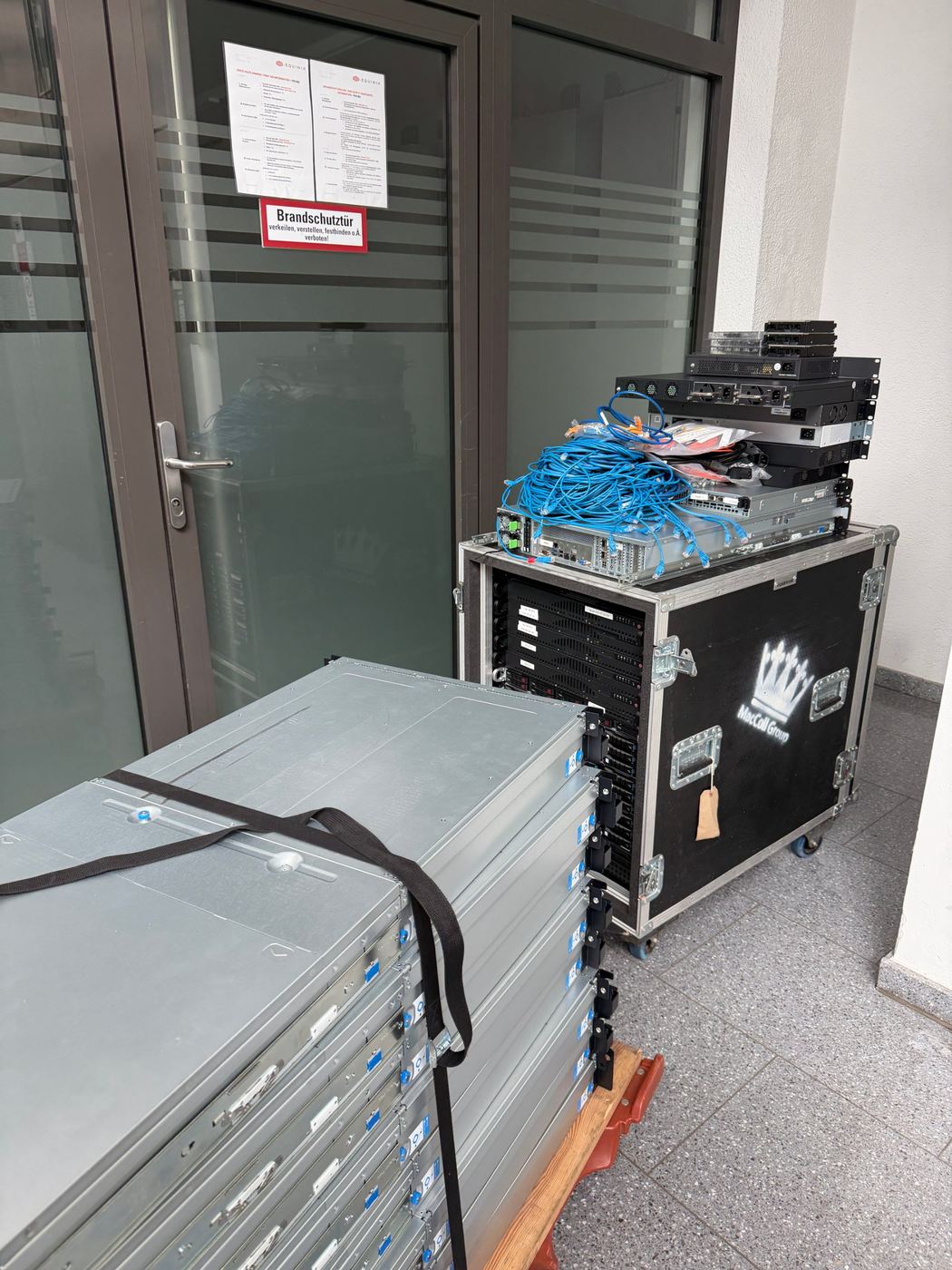
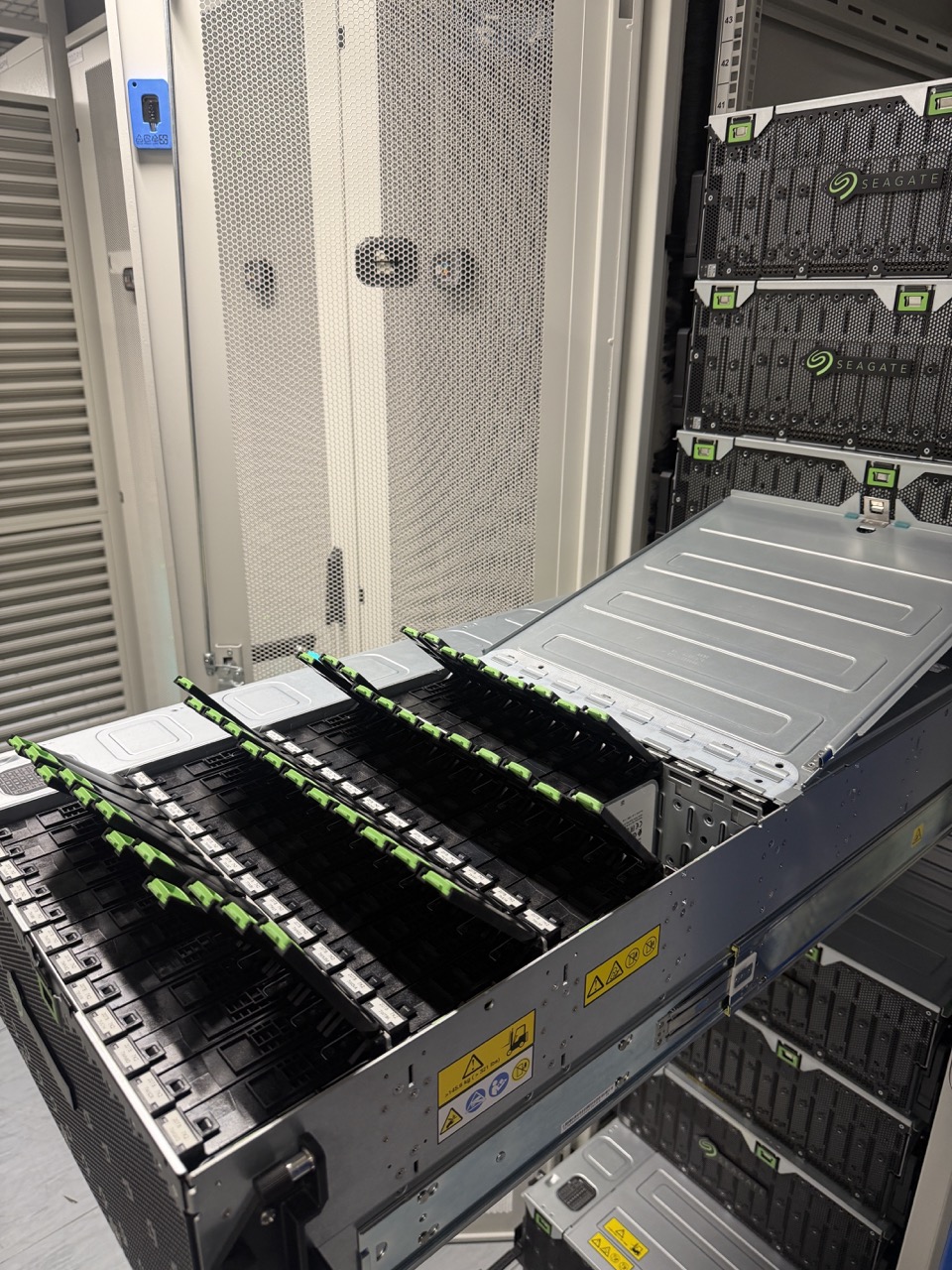
Rack servers and two Seagate 4U storage enclosures, each fully loaded with drives. A populated enclosure is a two-person lift at the very least.
Preparing servers for air freight
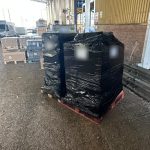
Servers for air freight have to be packed for the aircraft and the handling either side of it, not just the road. Everything was de-racked, packed and built onto pallets, then shrink-wrapped and labelled for the airline.
Each pallet is weighed and measured before it goes, because air freight is charged on whichever is greater, the actual weight or the volume. A tightly built pallet costs less to fly than a loose one.
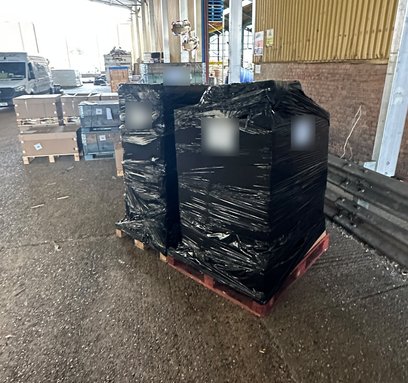
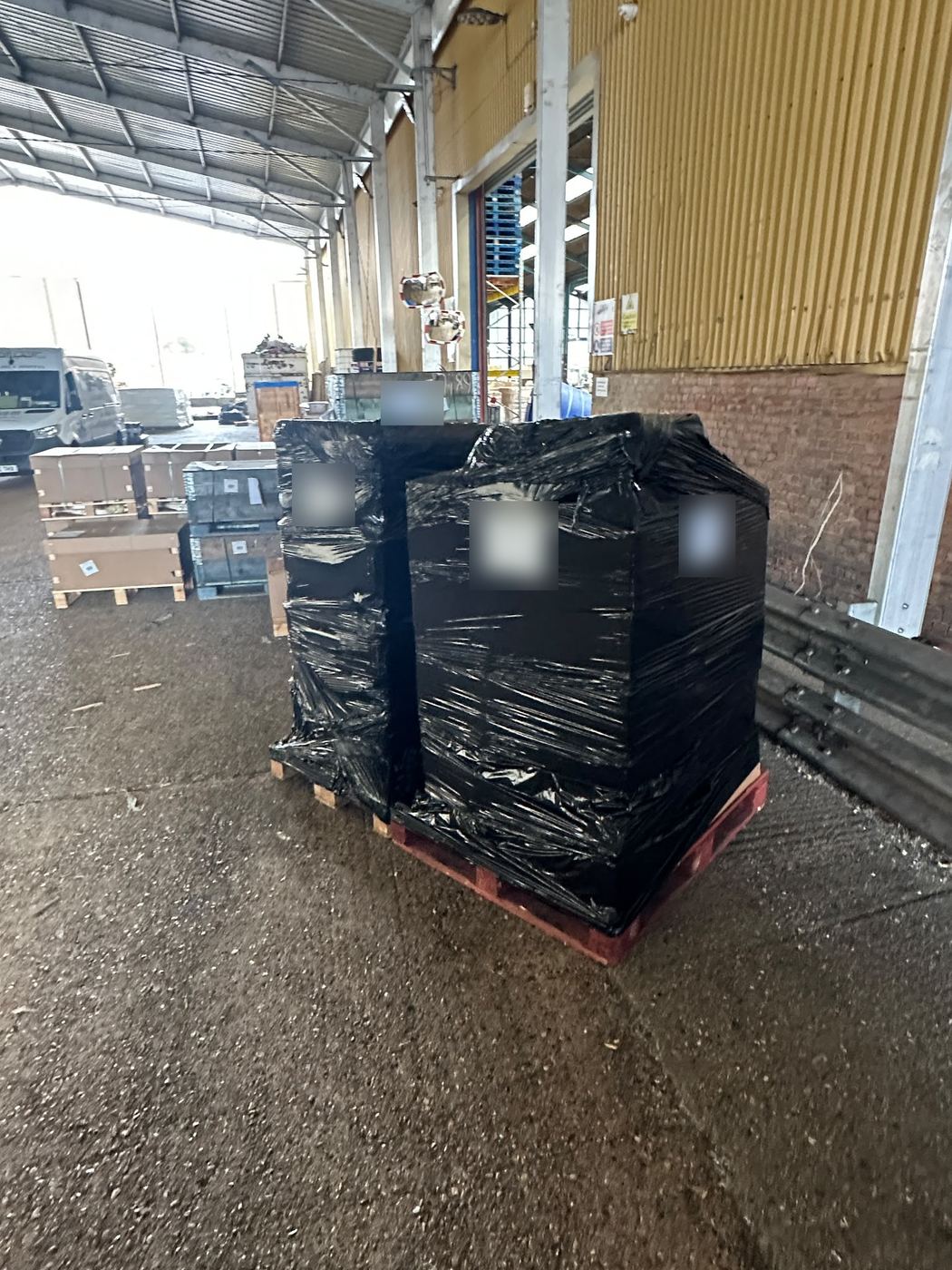
Three pallets, wrapped and labelled for air freight
The paperwork that decides the trip
The hard part of sending servers to the USA is rarely the flight. Before anything leaves, someone has to be the importer of record, the declared value has to reflect what the equipment is worth today rather than what it cost, and the duty at the US end has to be understood. Get those settled before the kit is packed, not once it is sitting at the airport.
Frankfurt Data Centre Move: Three Floors into One in a Day
In October we moved an online backup provider’s equipment between two Equinix data centres in Frankfurt, from FR5 to FR2. At FR5 the kit sat in racks on three different floors. At FR2 it all went into one location. This Frankfurt data centre move started at 09:00 on a Saturday and finished at around midnight.
We had moved the same client’s London equipment earlier in the year, so this was a second move for a returning client.
What moved
62 devices, 104U of equipment, about 1,760 kg in total
43 × 2U servers
2 × 4U 60-bay storage chassis, around 100 kg each
10 × 1U servers
7 switches
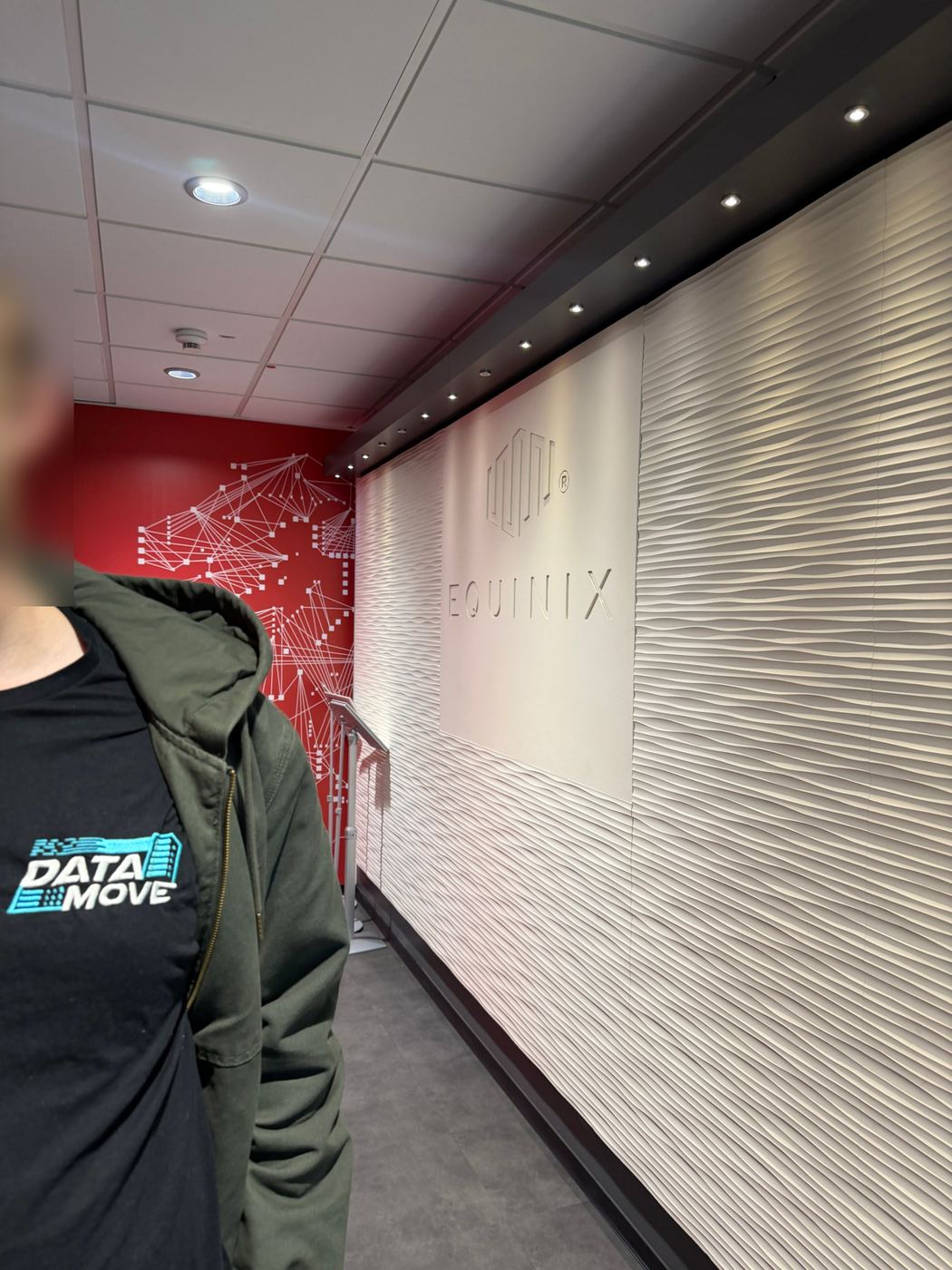
Arriving at Equinix, Frankfurt
Why a 12-tonne lorry
At around 1,760 kg, the load was more than a large van can legally carry. We drove a 12-tonne vehicle over from the UK with a crew of four and eight 14U rack-format flight cases.
Staged at FR5: a rack-format flight case and a strapped pallet of servers
Three floors into one
Consolidating racks from three floors into one location changes the job. Every device needs a planned position in the new racks before it leaves the old ones, so nothing ends up on the data hall floor at FR2 waiting for a decision about where it goes.
The day itself
Access was delayed by an hour by a system outage at Equinix, which nobody on site could do anything about. With three floors to clear and one location to build, the day ran long. We finished at around midnight, with everything racked at FR2.
When you plan a move inside a data centre campus, allow for access delays. Booking and security systems do go down, and a Saturday window is only as long as the site lets it be.
Belfast to Dublin in a Day: Moving a Server Room into a Colocation Facility
In November we moved an IT services company’s equipment out of its office server room in Belfast and into a colocation facility in Dublin. Collection, the drive south, racking and sign-off were all done in one working day, from 09:00 to 15:00.
This is how the Belfast to Dublin move ran, and the one thing on the day that didn’t match the plan.
What moved
An HPE BladeSystem c7000 chassis with 16 blades
Storage arrays
Switches and network equipment
The office server room in Belfast, before the uplift
From an office to a data centre
The client was consolidating out of an office-based server room and into a proper colocation facility, with the power, cooling and security an office can’t match. That meant a full uplift: everything powered down and de-racked in Belfast, moved in a single run to Dublin, and re-racked the same afternoon.
The blade chassis travelled in one of our rack-format flight cases, so it was never carried loose or stacked.
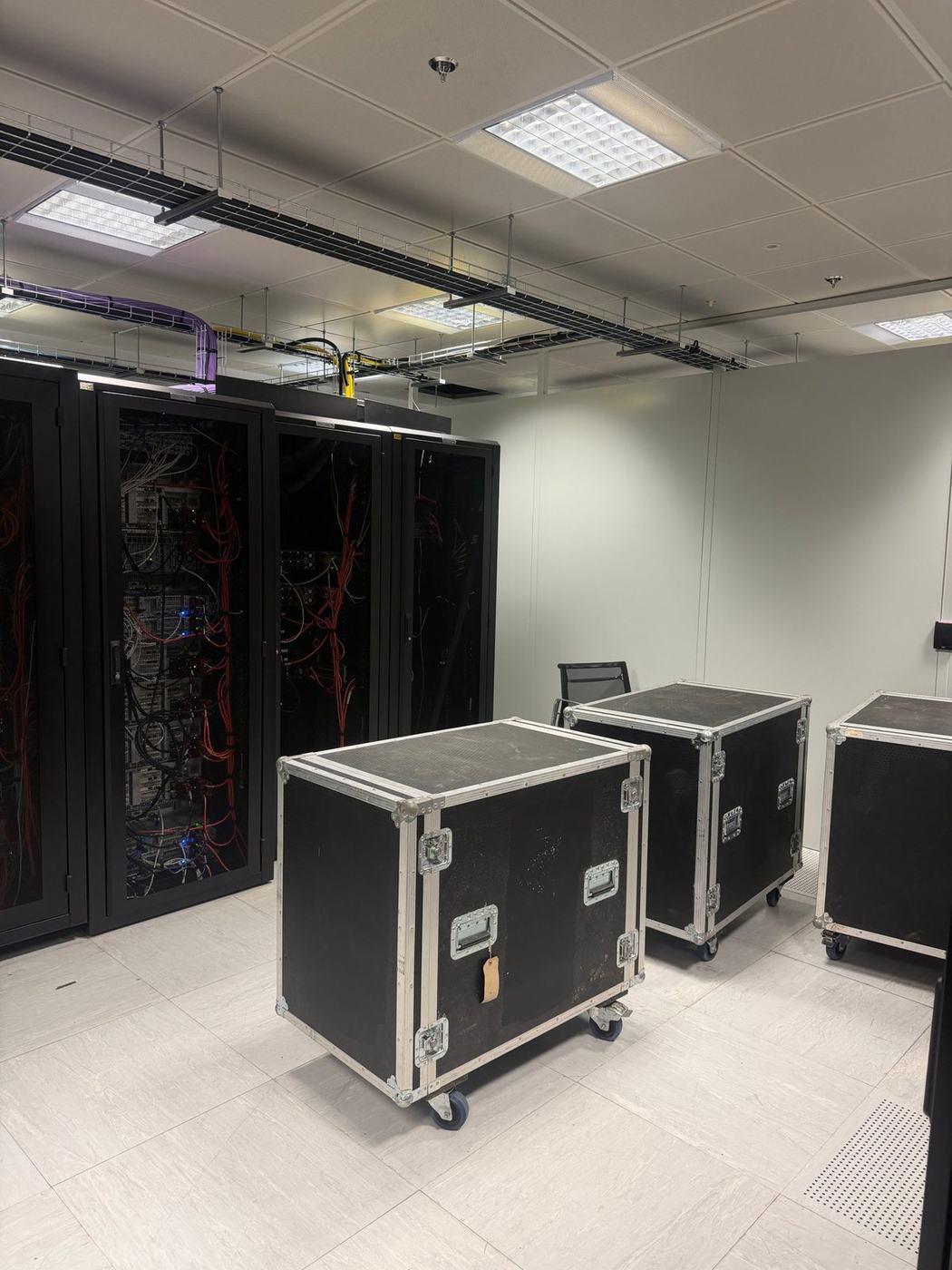
Rack-format flight cases on the floor in Dublin
Every unit had a place before we arrived
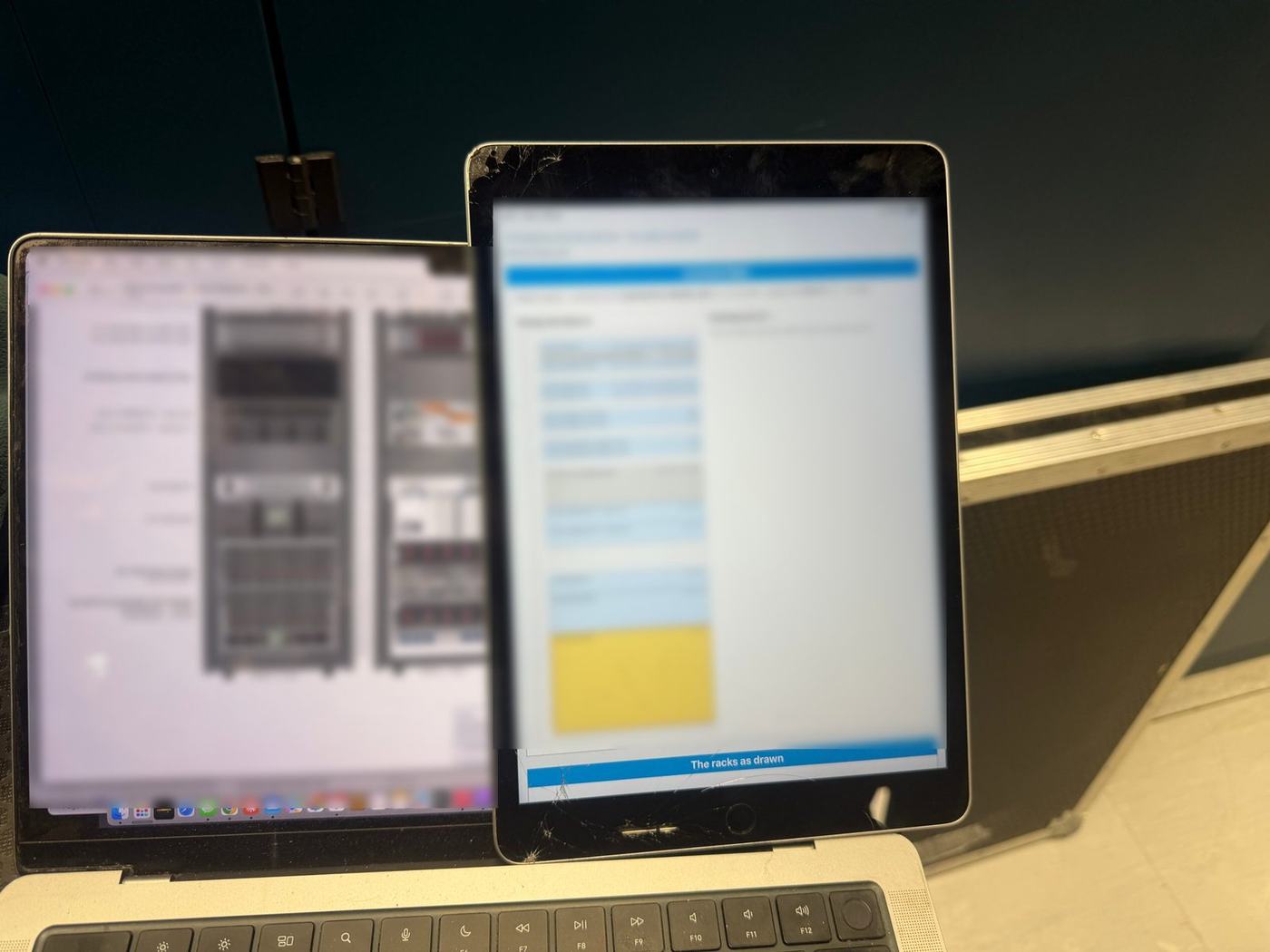
Before the day, each device was given a position in the destination rack. On site we worked from the client’s rack drawings and from our own rack-planning tool on a tablet, which shows where every unit is going by U position and lets the crew scan a unit to find its slot.
Rack drawings on the laptop, our rack-planning tool on the tablet (details blurred)
The one surprise: U2
The plan had the blade chassis starting at U2. In Dublin, the rack’s rail adjustment brackets sat right beside the U2 position, so nothing could be mounted there. We raised everything to start from U3. There was room in the rack to absorb it, so the plan held and the day finished on time.
When you plan a move, check the first few units of the destination rack, not just the total space.
Belfast to Dublin: crossing the border
Belfast to Dublin is a cross-border move, but a simpler one than most. Under the Windsor Framework, Northern Ireland follows EU rules for goods, so there are no customs declarations between Belfast and Dublin, unlike a move from Great Britain into Ireland. VAT is a separate question: equipment moving from Northern Ireland to Ireland falls under the EU’s VAT rules, and the owner may need to report the movement, so check with your accountant before the day.
Moving a Storage Array: Why Every Drive Goes Back in the Same Bay
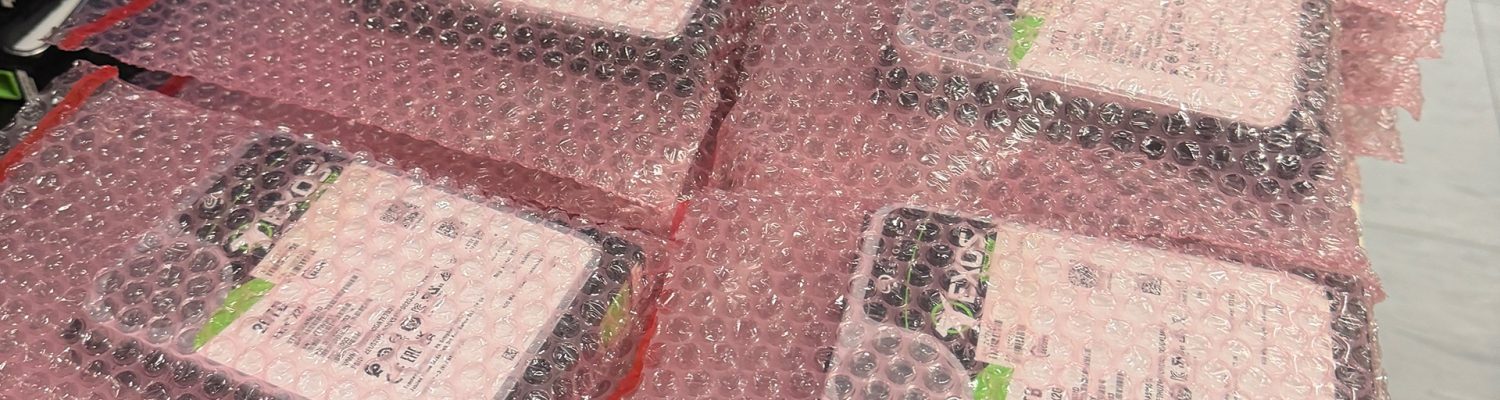
This autumn we moved eight Seagate Exos CORVAULT 4U106 storage chassis, holding 848 drives between them, from Telehouse North in London to a post-production facility in Burbank, California. Each drive was removed, bagged and labelled against its chassis and bay, packed 20 to a carton, and refitted to the same slot on arrival, ten floors up in Burbank. This is how that works, and why it matters.
Moving a storage array is not like moving a server. Most servers can travel with their drives in place. High-density storage cannot.
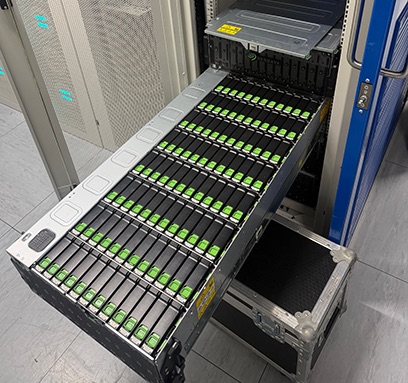
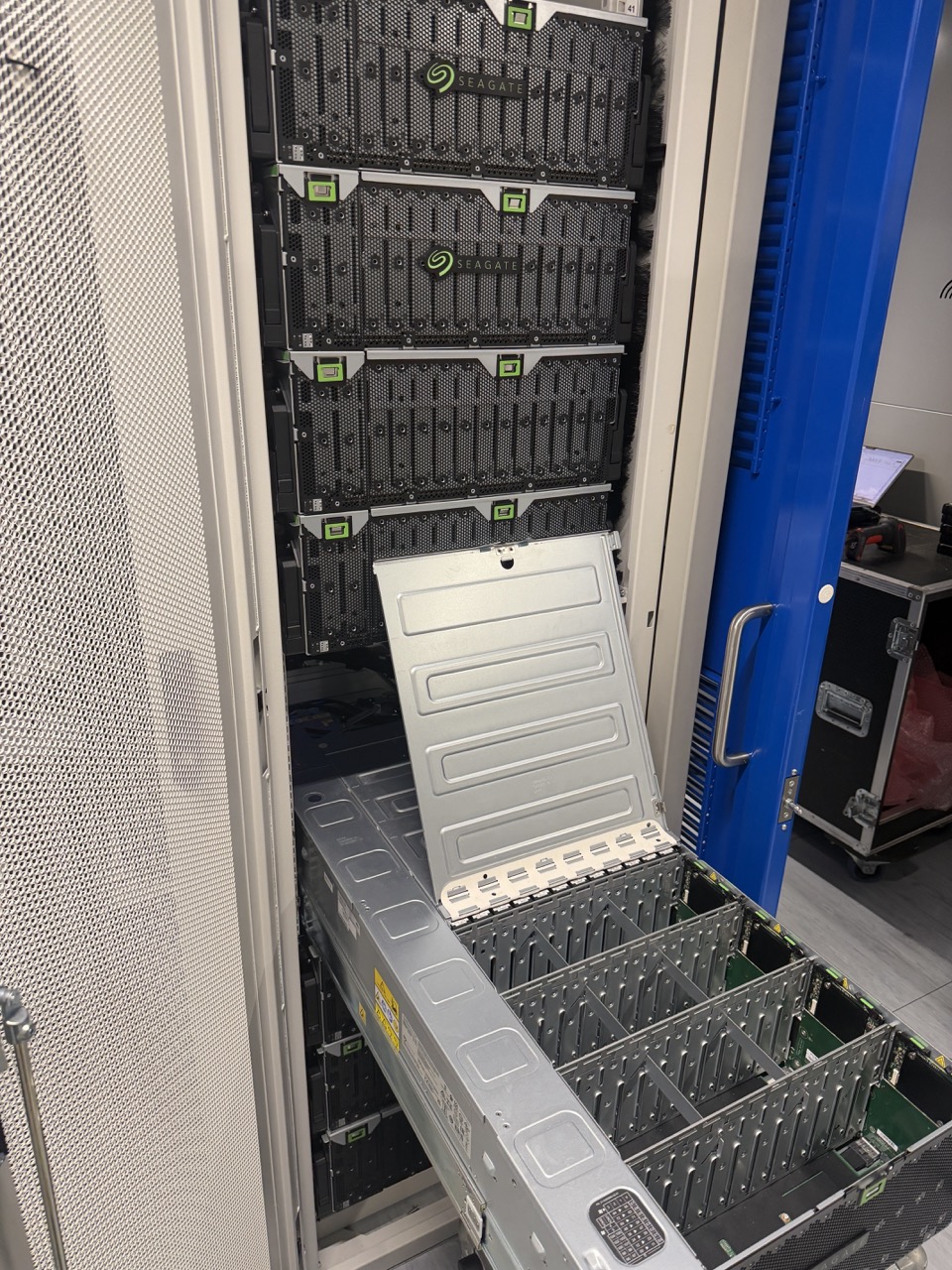
A modern 4U storage chassis can hold over a hundred hard drives. Fully populated, a single chassis weighs around 100 kg, against roughly 43 kg empty. The drives are loaded from the top rather than hot-swapped from the front, and the chassis is not built to carry their weight on the road or in the hold of an aircraft. So before anything moves, every drive has to come out.
That is where most of the risk sits. Not in the lifting, but in what happens when the drives go back in.
Hard Drives Being Removed from Large Array
Why drive position matters
Arrays like these do not treat drives as interchangeable. Data is spread across them using erasure coding, and the controller expects each drive in a known position. Put the right drives back in the wrong bays and, at best, the array spends days rebuilding. At worst, you are restoring petabytes from backup.
So the job when moving a storage array is not simply to remove the drives. It is to remove them in a way that guarantees each one goes back exactly where it came from.
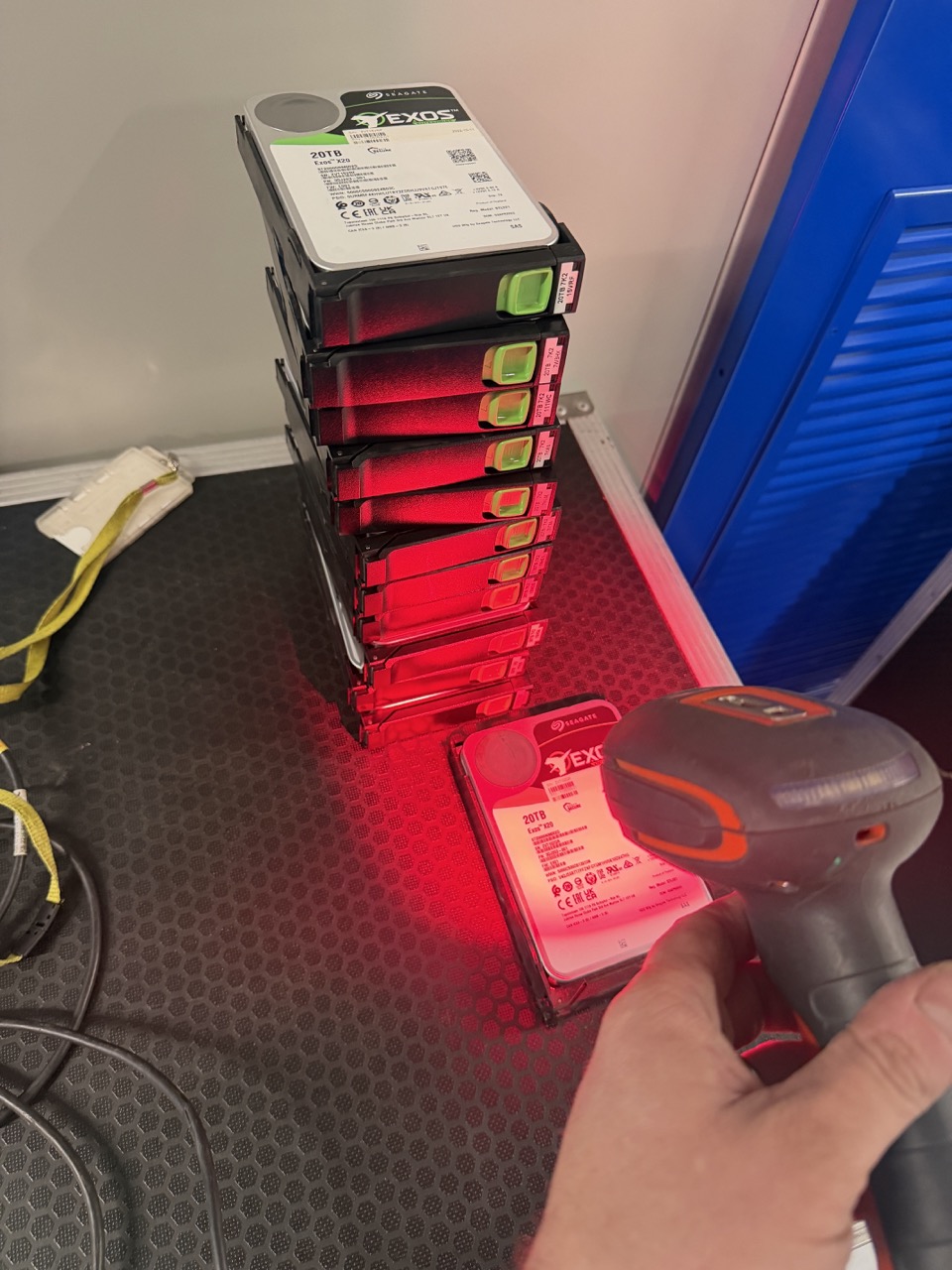
Scanning drive serials for audit and tracking on our in house CRM system, and individual labelling for position tracking.
How we approach moving a storage array
Every drive is scanned by serial number as it comes out of the chassis and recorded against two things: the chassis it came from and the bay it sat in.
Each drive is then individually anti-static bagged and labelled with that chassis and bay position. The record and the label say the same thing, so the drive can be placed correctly whether you are reading the paperwork or the bag.
The drives are boxed in purpose-made hard drive cartons and travel on the same pallet as their own chassis. Nothing is consolidated across chassis. If a pallet is delayed, the drives for that chassis are delayed with it, rather than arriving separately and waiting to be matched up.
At the destination, the record works in reverse: chassis by chassis, bay by bay, against the serial numbers captured at origin.
Bare chassis ready for removal and packing
Packing for the journey
Empty chassis are packed in anti-static protective material, two to a pallet, with their drive cartons secured alongside. Pallets are built to standard airliner belly-hold dimensions, with no oversize freight and no untreated timber, so there is no reason for the airline or customs to hold them.
What the client is left with
The drive record does not stop being useful once the array is back up. It is a complete inventory of every drive by serial number, chassis and bay, captured on the day the equipment left. That gives the client an audit trail for insurance, a reference if a drive fails in the weeks after the move, and a baseline for the next time the platform is expanded or retired.
The useful question
If you are moving a storage array, ask whoever is moving it how they will make sure every drive goes back in the bay it came out of. If the answer is “carefully”, keep asking.
The Week Europe Locked Down: A Cross-Border Data Centre Relocation
In 2020 we took on what should have been one of the more straightforward cross-border data centre relocations on our books.
A gambling operator needed around three racks of HPE equipment moved from Leeds to its sites in Gibraltar and Malta, with a backload of old hardware coming home from both for disposal. Regulated sector, fixed destinations, well-understood route. We’d done variations of it before.
Twenty-four hours after our crew crossed into Europe with the outbound load, lockdown came into force.
The job didn’t change. Everything around it did.
The equipment was the same. The destinations were the same. The client still needed it delivered.
What changed overnight was every assumption the route was built on. Which borders were open.
Which roads a commercial vehicle could use. Whether a crew could stop, where they could rest, and what quarantine rules would apply at each crossing on the way back. Rules that had been stable for years were being rewritten by the day, and sometimes by the hour, in different ways in different countries.
The plan that left Leeds was obsolete before it reached its first drop.
Hardware being dropped off in Gibraltar in March 2020
What we actually did
Nothing dramatic. We kept checking.
Before every leg, the crew and our planning desk confirmed what was legal for that specific day — not what had been true when we set off. Where a rule was unclear, we got it clarified before moving rather than assuming and finding out at a border. The deliveries went ahead, the disposal backload was collected, and the question became getting the crew home.
That meant coming back through Italy, the country hit hardest and earliest in Europe at the time. It was the leg that took the most care: confirming the vehicle could transit, what the crew could and couldn’t do on the way, and what would apply when they reached the UK.
They made it home. The equipment was delivered. The old kit came back for disposal.
What it taught us about cross-border data centre relocation
The obvious lesson is that you can’t plan for a pandemic. That’s true and not very useful.
The more useful one is that the plan is only valid on the day you check it. We’d always treated the route as something decided at the start and then executed. Since 2020 we treat it as something re-confirmed before every leg, because the conditions a move depends on — borders, access, regulations, availability — can change underneath you while the vehicle is already moving.
The second lesson is about the crew. A route that changes daily needs people on the road who can think, not just drive. The crew that went out in 2020 were making judgement calls in real time, in contact with the office, on information that was hours old. That isn’t something you can script.
Hardware being dropped off in Malta
Why it still matters
It’s tempting to file this under a once-in-a-century event. It isn’t really.
Borders and rules still change quickly, just less dramatically. Brexit rewrote the paperwork for every UK-to-Europe movement. Tariffs have moved sharply in the last year. Facility access procedures change. Carriers fail — we’ve since had an air freight provider go into administration in the middle of a job. None of it makes headlines the way 2020 did, but all of it can change what’s possible between planning a move and completing it.
The discipline is the same: confirm conditions on the day, not at the start, and put people on the road who can adapt when they change.
The question worth asking
When you’re choosing someone to move equipment across a border, the useful question isn’t whether everything will go to plan. Across enough moves, something won’t.
It’s whether they’ll know on the day, and what they’ll do about it.
DataMove vehicle filling at a completely empty fuel station en route through France
Simultaneous Server Relocations to Malta and Gibraltar for Major Gambling Operator
When a major UK-listed gambling operator needed to simultaneously relocate switch infrastructure from Northern England to Malta and server equipment from Stockholm to Gibraltar, they turned to DataMove to manage both moves end-to-end — with zero disruption to their live operations.
The Challenge
The client was consolidating infrastructure across two regulated gambling jurisdictions. The project involved two separate but simultaneous cross-border moves, each with its own customs requirements, logistics chain and installation demands:
Move 1: 14RU of Cisco switch and network infrastructure from Northern England to a data centre in Sliema, Malta — requiring full reconfiguration after reinstallation
Move 2: 20RU of server equipment from Stockholm, Sweden to a data centre in Gibraltar — requiring customs clearance at the Spanish border before entry to Gibraltar
Both moves needed to run concurrently, with equipment arriving at its destination fully operational within six days of leaving the origin site. The client wanted a completely hands-off service — one provider handling everything from deracking to customs paperwork to final verification. This was a time critical project that demanded a specialist partner.
Our Approach
DataMove managed both relocations simultaneously using our own vehicles and engineering teams. Each move followed the same structured process:
Deracking and packaging: Equipment was carefully removed from the origin racks, labelled, documented and secured in specialist flight cases for road freight
Road freight: Both shipments were transported by road in DataMove vehicles — Northern England through France, Italy and then the ferry to Malta, and Stockholm through Denmark, Germany, Belgium, Luxembourg, France, Spain and finally into Gibraltar.
Customs clearance: All export and transit documentation was prepared in advance. Malta customs was pre-booked with payments cleared before arrival, ensuring no delays at the destination. At Gibraltar, the team managed the border crossing from Spain, including a three-hour wait for paperwork to be stamped and formally exited from the EU before entry to the territory. Our forwarder partners in Gibraltar ensured all import duties were received from us and cleared before arrival.
Installation and verification: At both destinations, equipment was reracked, cabled and powered on. The Cisco switches in Malta required full reconfiguration to the client’s specifications for their new project scope. Both installations were verified via video call with the client and followed by internal checks to confirm all systems were back online
Why Downtime Wasn’t the Issue
Unlike many data centre migrations where minimising downtime is the primary concern, this project was about redeploying valuable infrastructure to new jurisdictions. The equipment being moved was staging infrastructure with redundancy already in place at third-party data centres, so live services were unaffected throughout.
The priority was retaining the value in existing hardware and reusing it at the client’s new operational bases in Malta and Gibraltar — avoiding the cost of purchasing extremely expensive new equipment while ensuring the relocated kit was fully operational on arrival.
The Outcome
Both moves were completed within six days, on schedule and without incident. The client’s infrastructure was live at both destinations, verified remotely, and the entire project was delivered with what the client described as a fully “hands-off” experience.
The project demonstrated DataMove’s ability to manage multiple simultaneous cross-border relocations across different jurisdictions — coordinating customs, logistics, engineering and client communications in parallel.
Need to Move Infrastructure Between Jurisdictions?
Whether you’re relocating servers to Gibraltar, Malta, Cyprus, Sweden or the Channel Islands, we handle the entire process — packaging, customs clearance, specialist transport and installation. One provider, one point of contact, completely hands-off.
1. Gibraltar, as well as Cyprus, Malta and Sweden are popular hosting destinations for the worlds leading online gaming and sports betting companies. DataMove has worked on behalf of the biggest sports-betting companies globally in all of these locations.
2. DataMove were asked to move £250,000 worth of vital processing servers and associated equipment from two sites – Harrogate and Newport in the UK – to GibTel in Gibraltar – the British Overseas Territory.
Being high value and not to mention data sensitive equipment, the client required a dedicated van service – door to door and full rack, stack and patch both ends.
3. Project Manager Alex established a clear plan and immediately lodged an import record for the manifested goods with HM Customs Gibraltar with our preferred partner on the ground in Gib.
Prepayment of import taxes is important so as not to delay shipments into Gibraltar. Alex assigned two engineers and one of our euro spec Sprinters to carry out the work door to door in four days.
T1 documents were logged with HMRC and all paperwork’s were in place. This was a bit easier before Brexit but nonetheless standard for us now – we carry out cross border shipments weekly. Before or after Brexit, entry into Gibraltar has always been entertaining.
4. The Team carried out a full audit and port map at point of de-rack as these devices would have different elevations at the destination site. Between the two sites, there were 28 HP DL360 G10 devices and a handful of networking devices also being transported to the destination.
After a night stop at a secure compound near Folkestone, the team collected documentation near Ashford and boarded the tunnel for France. Gibraltar is a two to three day drive.
A few days later… cleared customs at La Línea de la Concepción and into Gibraltar. A relatively simple rack and stack and final ports map followed by a couple of hours remote troubleshooting to ensure our client was fully online and all devices visible.
5. Our skilled engineers ensured that this fast paced high security job was carried out in a timely and professional fashion.
Data Centres aren’t exactly glamorous but it can be nice to swing by the sunny climes of Gibraltar and Spain once in a while !
After the job was completed, this client usually has our engineers on standby for 24 hours or one full working day in case any problems arise or they require any further patching and this time it was no different.
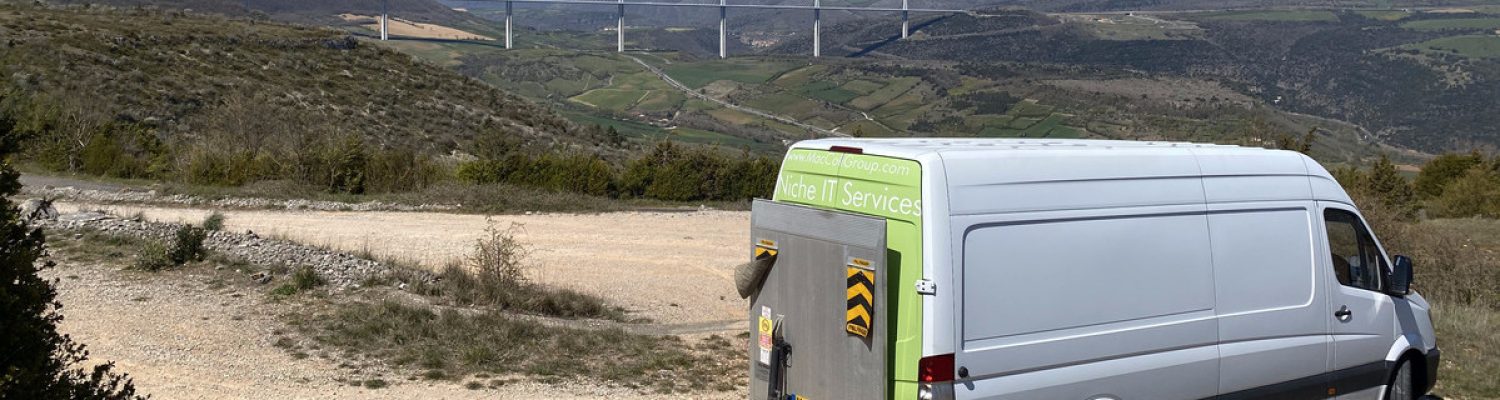
Once this was completed, our team were back on the road and even took in a bit of sightseeing on the way back – admiring the beautiful Norman Foster creation – the Millau Bridge. What a sight to behold!
For more information about our cross border data centre relocations, contact us today!
Servers in Gibraltar
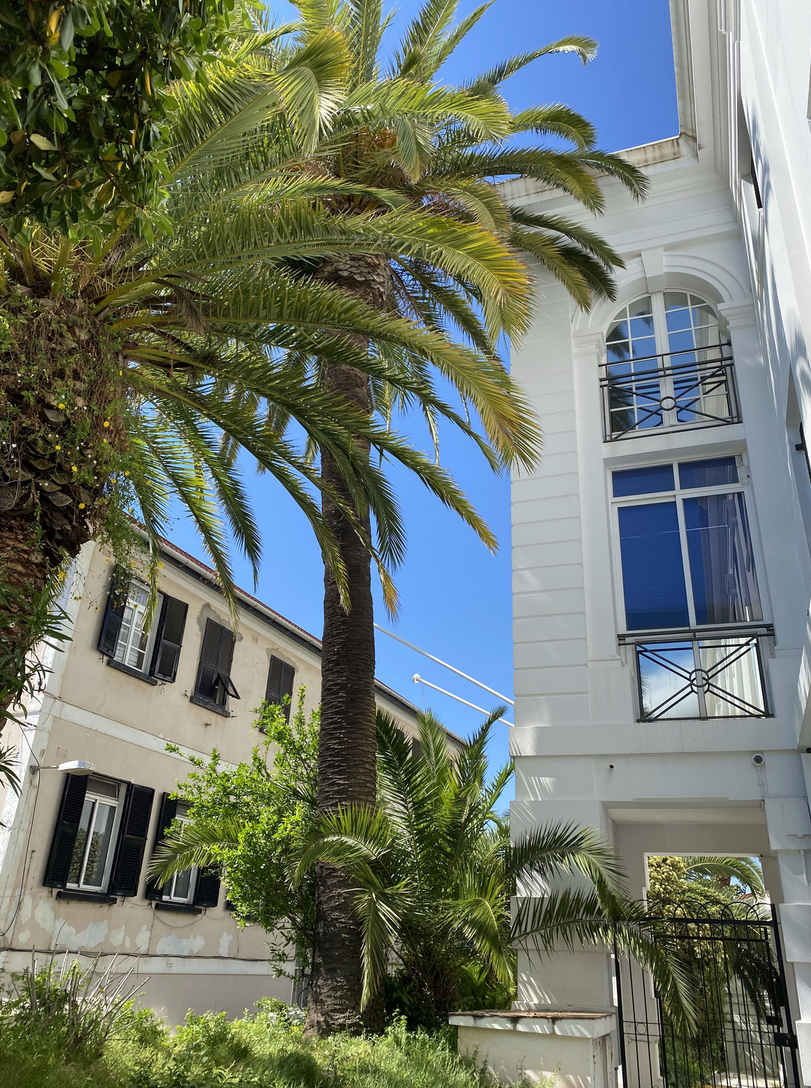
Gibraltar data centre building
Ready to Get Started?
Our specialists are ready to tailor our security service solutions to fit the needs of your organization.